

You Didn’t Polish That
The margin of error isn’t in the outcome. It’s in the story you tell about why it happened.

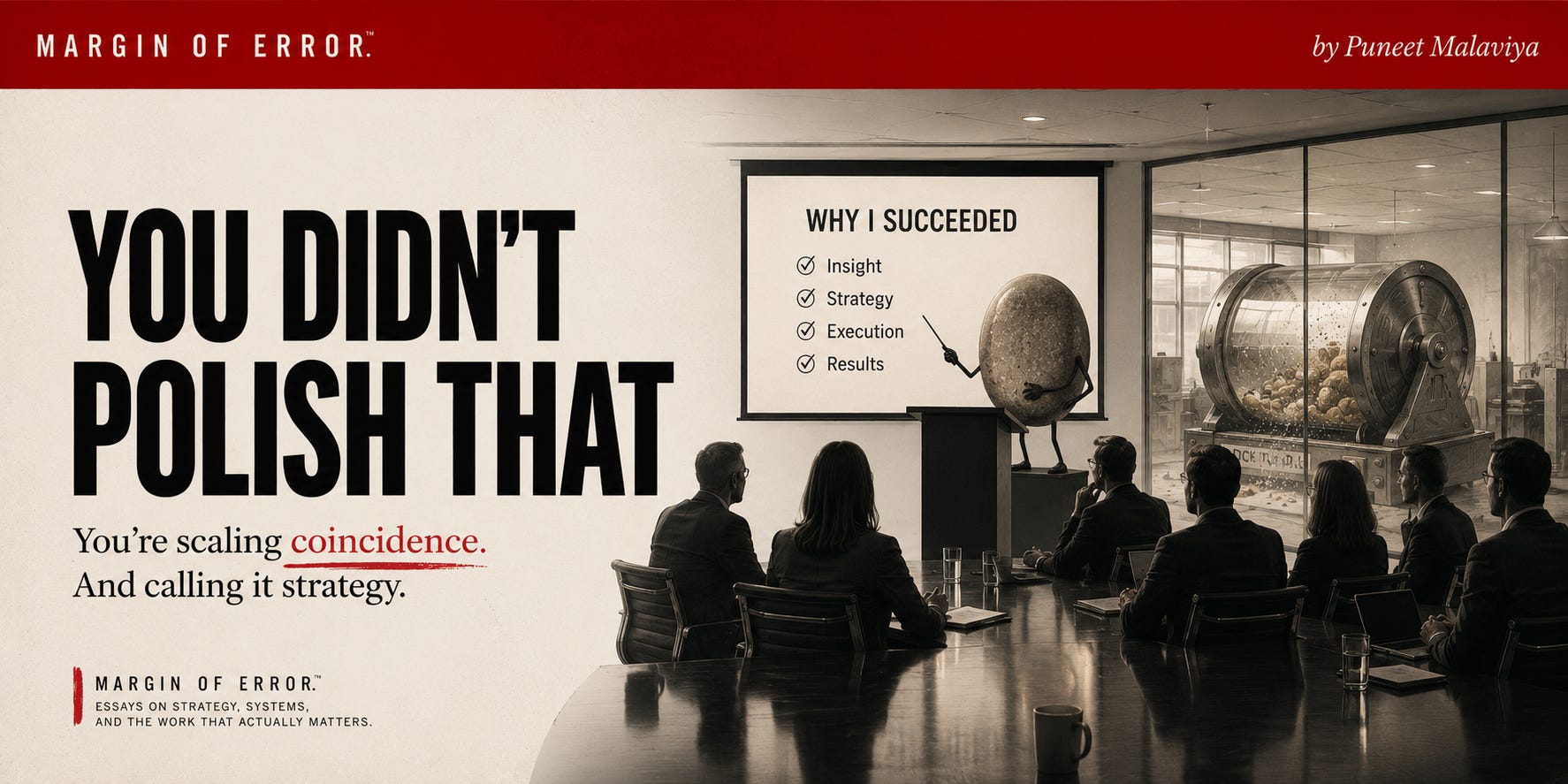
There’s a machine called a rock tumbler.
You load it with rough stones, add abrasive grit, add water, seal it shut, and walk away.
Weeks later, you open the barrel and pull out smooth, polished stones. Some emerge beautifully. Some don’t. Some crack.
Nobody asks which stone did the best work.
Yet every post-mortem I’ve ever attended sounds exactly like that conversation.
A campaign works. A product launches successfully. A quarter closes ahead of target.
The deck opens. The charts appear. And someone begins explaining how the result happened.
We identified the insight.
We built the strategy.
We executed the plan.
We delivered the outcome.
The stone, explaining how it polished itself.
People laugh when they hear that analogy.
Then they go back to doing exactly that.
The strange thing is that most people don’t see a problem with it.
Organisations depend on it.
Because every organisation eventually faces the same questions:
Who deserves credit?
Who should get more budget?
Who should run the next project?
Who should get promoted?
Outcomes alone can’t answer those questions.
The organisation needs a story.
So someone provides one.
Most post-mortems follow the same structure.
Outcome first. Narrative built backwards. Causality assigned selectively.
The chart goes up. The story gets cleaner. Everything uncomfortable disappears.
Nobody puts a slide into the deck titled: Things That May Have Helped But We Can’t Quantify.
Nobody presents a framework called: Luck.
Nobody asks: What if our explanation is wrong?
Not because these questions are irrelevant.
Because they’re inconvenient.
Notice how success is discussed.
Rarely as probability. Almost always as causality.
The campaign succeeded because of the creative.
The launch worked because of the positioning.
Sales grew because of the media plan.
The outcome becomes evidence. The evidence becomes explanation. The explanation becomes knowledge.
That’s where the trouble starts.
Imagine a campaign that delivers 25% growth.
The post-mortem credits the creative platform.
It makes sense. The creative was strong. The numbers were strong. Case closed.
Except nobody mentions that the category leader was out of stock in several major markets.
Nobody mentions that a key competitor pulled media spend midway through the quarter.
Nobody mentions that distribution expanded at the same time.
Nobody mentions that the category itself was growing.
Not because anyone is hiding those facts.
Because the organisation has already found a cleaner story.
The creative becomes the hero, because heroes are easier to discuss than systems.
Three months later, the creative framework is being replicated.
Six months later, it’s a best practice.
A year later, it’s in the company playbook.
The uncertainty has vanished.
The story remains.
This happens everywhere.
One successful launch becomes a methodology. One successful campaign becomes a framework. One successful executive becomes a leadership model.
The organisation doesn’t just explain success.
It institutionalises the explanation.
That’s a bigger risk than most people realise.
A failed campaign dies quickly.
A bad explanation can survive for years.
The real problem isn’t attribution.
It’s what attribution does to incentives.
Careers are built on explanations. Not outcomes. Explanations.
Outcomes are the raw material. The real competition starts after the result arrives.
Who can explain it most convincingly?
Who can claim ownership?
Who can connect themselves to success and create distance from failure?
The person with the strongest explanation walks away owning an outcome they only partially created.
The person asking uncomfortable questions walks away looking uncertain.
One gets promoted.
The other gets described as lacking executive presence.
Two marketers walk into a review meeting.
The first says: “Sales grew 18%. Here’s exactly why. Here’s the framework. Here’s how we’ll replicate it.”
The second says: “Sales grew 18%. We contributed, but competitor weakness, category growth and distribution gains likely played a role. I have hypotheses, not enough evidence to claim causality.”
Who sounds more capable? Who sounds more promotable? Who gets the bigger budget?
The question answers itself.
Not because the first marketer understands the business better.
Because certainty is easier to evaluate than honesty.
This is where organisational behaviour enters the picture.
Most organisations claim they want learning.
What they reward is certainty.
Those are not the same thing.
Learning begins with admitting you don’t fully understand something. Certainty begins with claiming that you do.
The person who says “I don’t fully know why this worked” sounds hesitant.
The person who says “Here’s exactly why it worked” sounds decisive.
One may be demonstrating intellectual discipline. The other may simply be demonstrating confidence.
The organisation can’t tell the difference.
So it defaults to something simpler: narrative quality.
Over time, this creates a selection mechanism. The people who construct the cleanest stories rise. The people who can articulate uncertainty struggle.
Eventually the organisation fills with people who can explain success beautifully.
And reproduce it inconsistently.
There’s another consequence.
The organisation slowly loses the ability to learn.
Not because it stops collecting data. The opposite.
More dashboards. More scorecards. More reviews. More attribution models. More post-mortems.
Every new layer introduced in the name of clarity.
Clarity never arrives.
Because these systems are built to answer the question the organisation wants answered:
Who caused the result?
The harder question remains untouched:
How certain are we that our explanation is correct?
Those are not the same question.
Most organisations spend enormous effort on the first.
Almost none on the second.
This is where the idea of Margin of Error becomes useful.
Not the statistical definition. The organisational one.
The real margin of error isn’t the gap between prediction and outcome.
It’s the gap between what happened and the story the organisation tells about why it happened.
Every organisation has one.
Some are small. Some are enormous. Most are invisible.
The danger isn’t that organisations get attribution wrong occasionally. Everyone does.
The danger is that they get it wrong consistently enough to build careers, frameworks and cultures around the mistake.
The story gets repeated. The framework gets documented. The methodology gets scaled.
The explanation hardens into doctrine.
Eventually nobody remembers where the story came from.
Only that it became accepted wisdom.
This isn’t an argument against accountability.
Outcomes matter. Process matters. Skill matters. Loading the tumbler well matters.
But control and craft are not the same thing.
A mature organisation evaluates people on the quality of decisions made under uncertainty, not merely the outcomes that emerge afterwards. It rewards disciplined thinking even when outcomes disappoint. It stays sceptical of simple explanations attached to complex results.
That sounds obvious.
It’s remarkably rare.
Most organisations don’t have a marketing problem.
They have an attribution problem.
And until they can tell the difference, they’ll keep putting the polished stones in charge of the tumbler.